
The portals own the transaction query. Rightmove will always outrank an individual estate agent for “houses for sale in Clapham.” Zillow will always outrank an independent broker for “homes for sale in Austin.” That is not the battle worth fighting. The battle worth fighting — and winning — is the relationship query: “best estate agent in Clapham,” “Clapham property market 2026,” “how much is my house worth in Clapham.” These are the queries that portals, with their database-driven architecture, are structurally incapable of answering well. And they are the queries where a locally authoritative agent, with genuine neighbourhood knowledge and a properly optimised Google Business Profile, wins consistently.
This guide covers the complete local SEO playbook for real estate agents: neighbourhood page architecture, GBP optimisation for agents and brokerages, review velocity systems, NAP citation consistency, suburb-level content strategy, and local schema implementation. For the broader strategic context — including IDX SEO and GEO citation strategy — see our full Real Estate SEO guide.
What This Guide Covers
- Neighbourhood pages: the hyperlocal content portals can’t replicate
- GBP setup and optimisation for real estate agents
- Review velocity: the local ranking signal most agents ignore
- NAP consistency and citation building for agents
- Suburb content types: what to write for each area you serve
- Local schema for agent and brokerage websites
- Local SEO audit checklist for real estate agents
- Frequently asked questions

Neighbourhood Pages: The Hyperlocal Content Portals Can’t Replicate
The fundamental difference between a portal’s suburb page and an agent’s suburb page is depth of local knowledge. Rightmove’s Clapham page shows current listings, average asking prices, and a heat map. An active Clapham agent’s suburb page — written from genuine experience — can cover the specific streets that command a premium (Rectory Grove, The Pavement), the primary school catchments that buyers with children filter by, the new development pipeline on Clapham High Street that will affect values over the next three years, and the typical profile of buyers currently active in the area. This is content that cannot be generated algorithmically from MLS data and cannot be replicated by a competitor who does not work in the area.
One page per suburb per intent
Each suburb in your service area should have dedicated pages broken out by intent: a general suburb guide (living in the area), a buyer-focused page (buying in the area), a seller-focused page (selling in the area), and a rental market page if relevant. These pages are not duplicates of each other — they serve different search intents and target different query clusters. Consolidating them into one page means competing for all three intents simultaneously and ranking well for none. Our 90-day SEO plan framework includes the phased approach for building this neighbourhood page architecture without producing thin content at scale.
Depth signals: what Google and AI systems reward
A neighbourhood page that ranks for competitive agent queries and gets cited by AI answer engines typically contains: the agent’s name (first person preferred), specific street-level price data from recent transactions, named schools with current Ofsted/rating data, transport links with specific journey times, proprietary market insight that cannot be found on the portal (time on market by property type, typical buyer profile, seasonal demand patterns). Length is less important than depth — a 900-word neighbourhood page with five specific local data points will outperform a 2,000-word generic overview every time.

GBP Setup and Optimisation for Real Estate Agents
Google Business Profile is the fastest-impact local SEO lever available to real estate agents because it directly drives 3-pack visibility for the highest-commercial-intent queries in agent search: “estate agents near me,” “real estate agent in [suburb],” “property agent [postcode].” A homeowner ready to instruct an agent typically performs this search before any other — and the three businesses in the 3-pack receive the overwhelming majority of the resulting calls and enquiries.
Category and service area configuration
Set the primary GBP category to “Real Estate Agent” (US/Australia) or “Estate Agent” (UK) — not “Property Management Company,” not “Real Estate Consultant,” not “Letting Agent” unless lettings is your primary business. The primary category is Google’s single strongest relevance signal for which queries your profile is eligible to appear for. Add secondary categories for every service type: “Property Management Company” if you manage rentals, “Commercial Real Estate Agency” if you handle commercial, “Real Estate Appraiser” if you provide valuations. For the detailed GBP mechanics that underpin 3-pack ranking across all service categories, our guide to ranking high on Google Maps in 2026 covers every signal in detail.
Service area must be defined at suburb and postcode level — not city level. An agent who defines their service area as “London” or “Sydney” is attempting to rank for every estate agent query in a city of millions rather than dominating the 8–12 suburbs where they actually have transactions, testimonials, and genuine expertise. Define 8–15 specific suburbs or postcodes. Google’s local algorithm rewards relevance and proximity for the specific areas listed.
GBP photo strategy for agents
GBP profiles with 20+ high-quality photos receive significantly more clicks than profiles with fewer photos, and real estate agent GBP profiles have a specific photo opportunity most agents underutilise: sold board photos. A sold board photo posted to GBP immediately after each transaction serves as a geo-tagged transaction signal — it communicates to Google that you are active in a specific street, in a specific suburb, right now. Post a sold board photo for every transaction. Tag it with the suburb. This is a local prominence signal that compounds with every completed sale.
Review Velocity: The Local Ranking Signal Most Agents Ignore
Review quantity, recency, and response rate are among the strongest signals in Google’s local ranking algorithm. An agent with 15 reviews from 2022 will consistently lose 3-pack positions to a competitor who has 60 reviews with the most recent from last week — even if the older agent has more transactions, a better website, and more backlinks. Recency matters more than volume, and both matter more than most agents realise.
The post-transaction review system
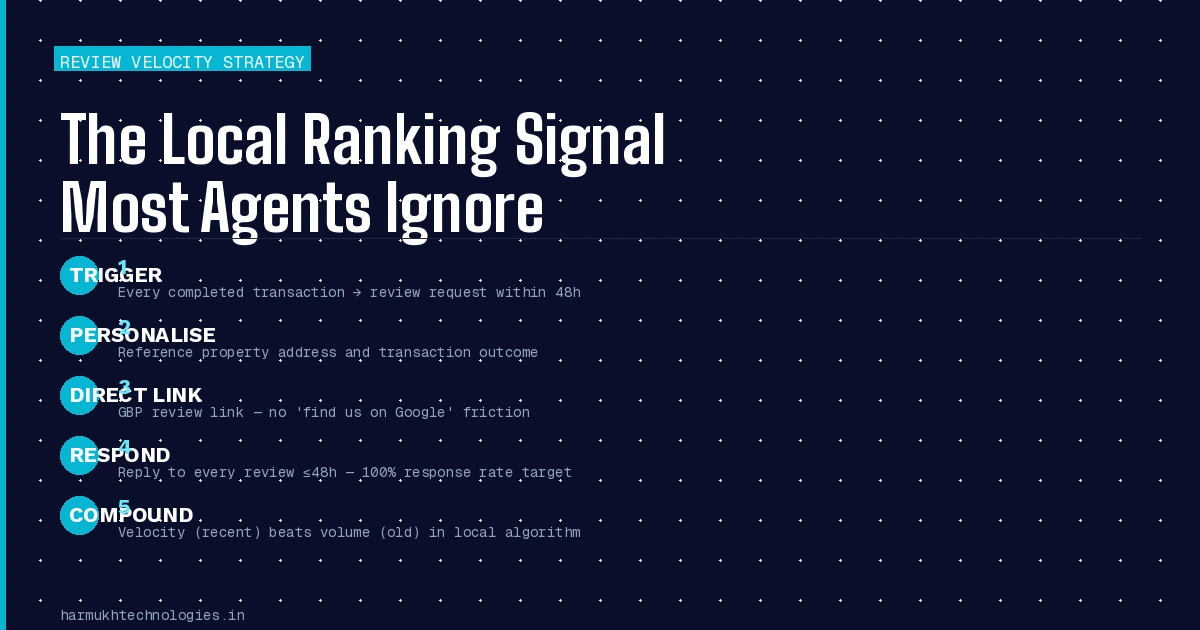
Every completed transaction — sale, purchase, let, management instruction — should automatically trigger a review request sequence. The sequence should be personalised (referencing the specific property and transaction outcome), timed correctly (within 48 hours of completion when satisfaction is highest), and make the review as easy as possible (direct GBP review link, not a general “please find us on Google” instruction). Agents who implement a systematic post-transaction review request process typically see review velocity increase by 300–500% within three months — which produces measurable 3-pack ranking improvement for suburb-level agent queries within 60–90 days.
Negative review response strategy
Response rate — the percentage of reviews (including negatives) that receive a public reply — is a verified GBP ranking signal. Responding to every review within 48 hours, including negative reviews, demonstrates active management of the profile and communicates responsiveness to both Google and potential clients reading the reviews. Negative review responses should be measured, professional, and offer to resolve the situation offline — not defensive, not accusatory. A professionally handled negative review often increases prospect confidence more than an additional positive review.
NAP Consistency and Citation Building for Agents
NAP — Name, Address, Phone — consistency across every online directory, portal, and citation source is a foundational local SEO requirement that most agents have never audited. A single address format discrepancy between your GBP (“St.” versus “Street”), your website footer, your Rightmove profile, and your Zoopla listing is enough to introduce ambiguity into Google’s local entity resolution — which suppresses 3-pack ranking for your target suburb queries.
Core citation sources for real estate agents
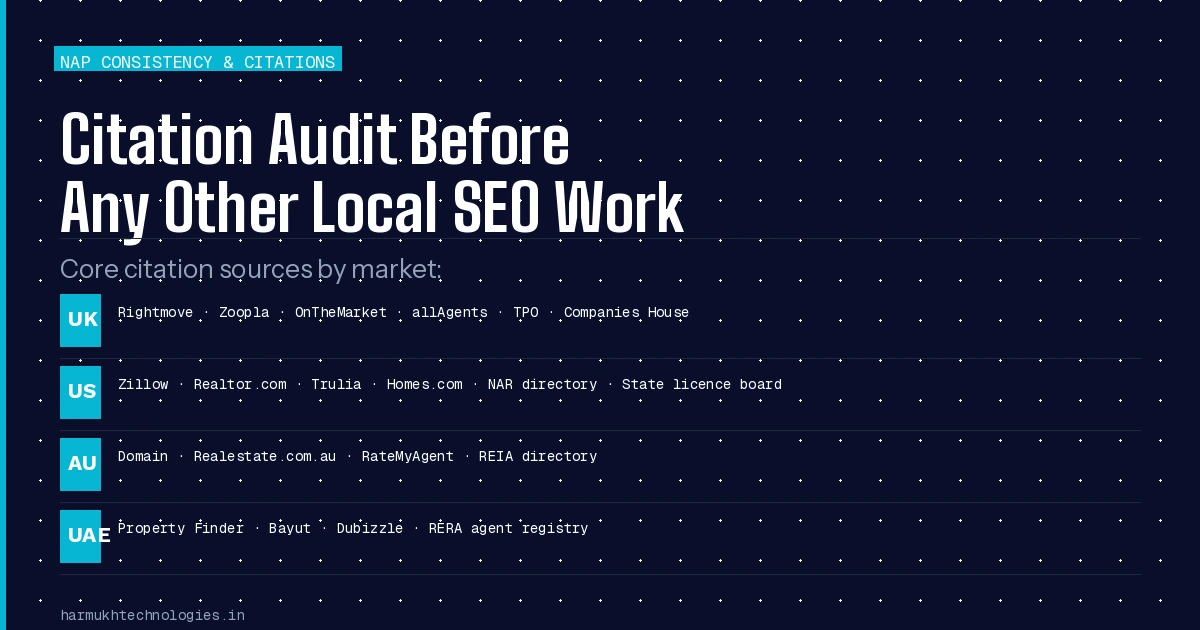
Priority citation sources vary by market. For UK agents: Rightmove, Zoopla, OnTheMarket, allAgents, The Property Ombudsman directory, Companies House. For US agents: Zillow, Realtor.com, Trulia, Homes.com, the NAR member directory, state licensing board listings. For Australian agents: Domain, Realestate.com.au, RateMyAgent, REIA member directory. For UAE agents: Property Finder, Bayut, Dubizzle, RERA agent registry. Consistency of business name, address, and phone number across all of these sources — and across Google, Apple Maps, and Bing — is the citation audit baseline that must be completed before other local SEO work will reach its full potential.
Suburb Content Types: What to Write for Each Area You Serve
The most effective content for local real estate SEO is the content that directly answers the questions buyers and sellers in your service area are asking before they instruct an agent. This content exists at the intersection of professional knowledge and local expertise — and it is the content that AI answer engines cite most frequently for real estate queries because it contains the specific, verifiable data that generic content cannot provide.
The five content types every suburb needs
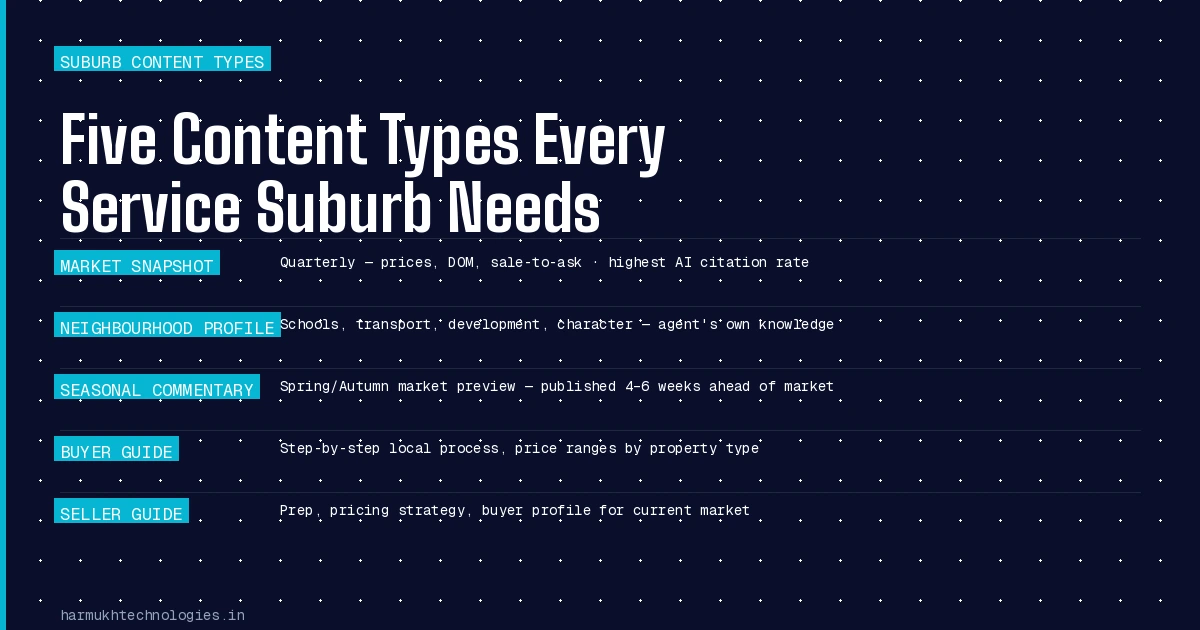
Market snapshot (quarterly): Average sale price, average days on market, sale-to-ask ratio, number of transactions — all specific to the suburb, for the most recent quarter. This content is date-specific (always current), data-specific (verifiable), and expert-attributed (your name, your data). It is the highest-citation-frequency content type in real estate SEO.
Neighbourhood profile: Not a tourist guide — a buyer’s research resource. School catchments with current ratings, transport options with journey times to key employment centres, development pipeline, flood risk if relevant, parking situation, street-level character variation. The questions every serious buyer asks before making an offer, answered in one place by someone who knows the area.
Seasonal market commentary: Published 4–6 weeks ahead of the spring and autumn markets, when buyer and seller search activity peaks. “What to expect from the [suburb] property market in Spring 2026” targets queries that portals cannot serve and positions the agent as the authoritative source for local market intelligence.
Buyer guides: “How to buy in [suburb]: step by step” — covering local-specific nuances, typical price ranges by property type, the competition landscape (how many offers typical properties receive), the timeline from offer to completion in this specific market. For content structure and on-page optimisation principles, our complete on-page SEO guide covers every element from title tags to internal link structure.
Seller guides: “How to sell your home in [suburb] in 2026” — covering preparation, pricing strategy for the current market, typical timeframes, what buyers in this area prioritise. Vendor research intent content converts at higher rates than generic content because it captures prospects at the decision stage.
Local Schema for Agent and Brokerage Websites
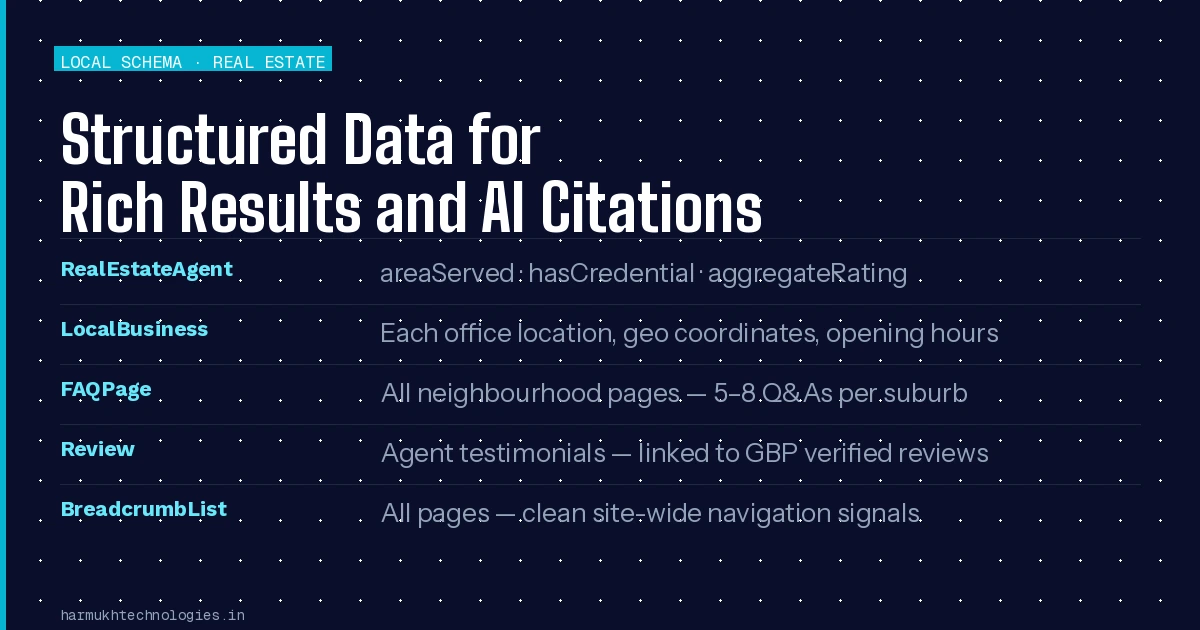
Local schema implementation for real estate agents covers three primary types: RealEstateAgent for agent profile pages, LocalBusiness for brokerage/office pages, and FAQPage for neighbourhood content pages. Each type serves a different function in how Google understands and displays the content in search results — and collectively they provide the structured data foundation that makes rich results and AI citations possible.
RealEstateAgent schema: required fields
The most commonly omitted fields in RealEstateAgent schema are areaServed (which should list specific suburbs and postcodes, not just the city), hasCredential (professional registrations — ARLA, NAEA, NAR, REIA, RERA), and knowsAbout (specific property types and service areas). These fields communicate to Google’s local algorithm not just who the agent is, but exactly where they operate and what queries they are qualified to answer. Combined with aggregateRating linked to verified review data, the RealEstateAgent schema provides a complete local authority signal that complements GBP data.
FAQPage schema for neighbourhood content
Every neighbourhood page should include a FAQ section with 5–8 questions specific to that area — and FAQPage schema marking up each question and answer. The questions should match the actual queries buyers and sellers ask: “What is the average house price in [suburb]?”, “Which schools are in the [suburb] catchment area?”, “How long do properties take to sell in [suburb]?” Each structured answer is independently citation-eligible for AI answer engines querying for neighbourhood-specific information. Our complete guide on real estate content strategy includes templates for building FAQ sections at scale across a multi-suburb service area.

Local SEO Audit Checklist for Real Estate Agents
Before investing in new content or citation building, audit the local SEO foundation that is already in place — because fixing existing signals is consistently higher ROI than producing new signals from scratch. Most agent websites have 3–5 quick wins available that can produce 3-pack movement within 30–60 days.
10-Point Local SEO Audit for Real Estate Agents
- GBP primary category correct — “Real Estate Agent” or “Estate Agent”
- GBP service area defined at suburb/postcode level (8–15 specific areas)
- GBP description contains target suburb names and service types
- GBP has 20+ photos including sold board photos from recent transactions
- Reviews: 30+ with recency in last 30 days; 100% response rate
- NAP consistent across GBP, website footer, all portal profiles
- At least one neighbourhood page per service suburb (unique content)
- RealEstateAgent schema on agent profile page with areaServed populated
- FAQPage schema on at least top 3 neighbourhood pages
- Website linked from GBP is the correct URL (homepage, not a redirected URL)
For the broader SEO trends shaping local search in 2026 — including AI Overview integration for local queries and the growing importance of GBP data in AI citations — our guide to 7 SEO trends defining 2026 is worth reading once your local foundations are in place.
Frequently Asked Questions
How many neighbourhood pages does a real estate agent need?
Can individual agents outrank large estate agency chains for local searches?
How do I build local SEO for multiple office locations?
Work with Harmukh Technologies on Local Real Estate SEONeighbourhood page production, GBP optimisation, citation audits, and monthly local rank tracking — handled end-to-end for agents and brokerages in the US, UK, Australia, and UAE.
View our local SEO services ·
Schedule a local SEO audit ·
Hire an SEO consultant
[…] making the page eligible for AI citation across multiple related searches. Our dedicated guide on local SEO for real estate agents covers the complete neighbourhood page architecture and content […]
[…] go beyond basic listings and implement advanced strategies tailored to their market. Investing in local SEO for real estate agents can help optimize Google Business profiles, build high-quality local […]